
Biceps Tendonitis: Symptoms, Causes, and Treatments
Book An Appointment
Key Takeaways
- Biceps tendonitis is characterised by pain and inflammation affecting the biceps tendon, which connects the biceps muscle to the shoulder socket.
- Biceps tendonitis is caused by overuse or injury to the biceps tendon, causing gradual damage to the tendon.
- Non-surgical treatments are the best way to treat biceps tendonitis, though severe cases will require surgical intervention.
What is Biceps Tendonitis?
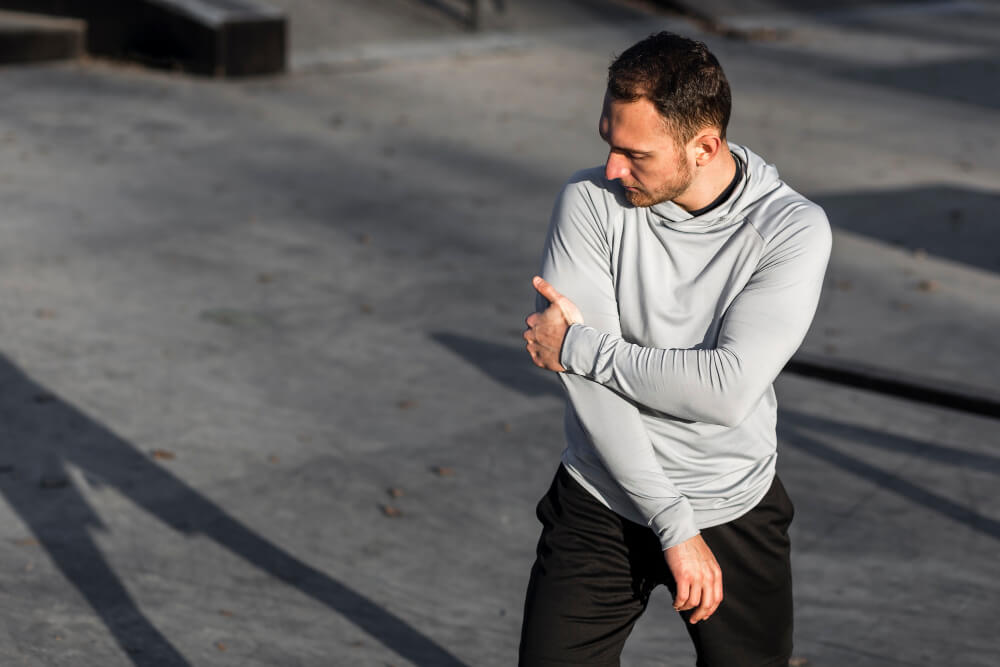
Biceps tendonitis is the inflammation of the upper part of the biceps, typically caused by overuse or injury to the biceps tendon. This tendon is a strong connective structure that connects the biceps muscle to the shoulder socket; while strong, overuse or injury can still cause gradual wear and tear, leading to inflammation and other complications. It commonly affects regular swimmers, golfers, and tennis players, especially as they frequently repeat overhead motions when participating in their respective sports.
What Causes Biceps Tendonitis?
We frequently use our arms for various activities, including sports, and over time, the tendons will undergo gradual wear and tear that causes them to weaken. If you sustain an injury to the tendon, that can also cause degeneration and weakening of the tendons. As you repeat various arm motions, the biceps tendon will continue to degenerate, increasing your risk of biceps tendonitis. Other conditions can also cause biceps tendonitis, including rotator cuff tears.
Symptoms of Biceps Tendonitis
The common symptoms of this condition include:
- Pain, swelling, or tenderness around the shoulder area.
- Increased pain when lifting your arm or reaching for your back.
- Weakness in your shoulder, arm, or both.
- A frequent snapping noise or sensation when moving your arm.
- Pain that may worsen without warning, especially at night.
How to Diagnose Biceps Tendonitis
Diagnosing with a Physical Examination
Your doctor will perform a physical examination to determine whether you have biceps tendonitis. In addition to taking your medical history, they will carefully assess your shoulder and arm. Depending on your condition, you may feel discomfort during the examination; be sure to let your doctor know how you feel. Your doctor will carefully inspect your shoulder and arm and slowly test its range of motion, among other things.
Using Yergason’s Test
Yergason’s test is a physical test that can detect various biceps-related injuries, including biceps tendonitis. You will be seated or standing with your upper arm in a neutral position and your elbow flexed at a 90-degree angle. Keep your elbow and upper arm close to the side of your body and ensure your palm faces the floor.
Your doctor will place their fingers along the front of your shoulder. They will keep their other hand gently holding your forearm and ask you to rotate your forearm, keeping your palm facing upwards and elbow remaining by your side, while simultaneously moving your forearm away from your body. As you do that, the doctor gently presses the area to identify any pain or tenderness you experience which results from biceps tendonitis.
Diagnosing with Imaging Tests
Additional tests can help confirm the diagnosis, especially if the physical exam does not give a satisfactory result. These tests could also help differentiate your condition from others with similar symptoms.
- X-ray scan: An X-ray can clearly show dense structures like bone, allowing the doctor to examine the biceps tendon for damage.
- Magnetic resonance imaging (MRI): This test may be needed if your doctor needs to examine the surrounding structures around your shoulder and along your arm to identify biceps tendonitis or other complications.
How to Treat Biceps Tendonitis
In most cases, nonsurgical treatment methods are the best way to help with your healing process. If necessary, surgery can help treat more serious cases of biceps tendonitis.
Treating Biceps Tendonitis Without Surgery
Treating Biceps Tendonitis via First Aid Techniques
The RICE method can help you reduce symptoms and manage pain.
- Rest: Avoid activities that put pressure/stress on the affected shoulder joint.
- Ice: Place a cold compress or ice pack in a towel on the affected area for 20 to 30 minutes, 3 or 4 times daily. Avoid placing ice directly onto your skin.
- Compression: Bandages or a compression wrap can be wrapped around the affected area to immobilise the shoulder or arm and decrease swelling.
- Elevation: Wearing a brace or sling can minimise your movements to help improve your recovery rate.
Treating Biceps Tendonitis via Physiotherapy
Physiotherapy can help you reduce pain and inflammation, strengthen your biceps tendons, and slowly restore your range of motion and flexibility. Your physiotherapist will show you various exercise methods to help improve your shoulder functions and gradually alleviate symptoms. As your condition improves, your physiotherapist will recommend slowly increasing the intensity and frequency of exercises to hasten your recovery safely.
- Bicep curls: While standing, hold a light object (a smaller dumbbell or water bottle will do) in your hand and place your arm to your side while keeping the palm facing forward. Straighten your upper arm as you slowly bend your arm at the elbow to lift the object. After that, slowly lower your arm to its starting position. Do this ten times, then repeat it three times a day. Be sure to take breaks between sets.
- Bicep stretches: Stand facing the front of a wall and raise your arm to shoulder height, palm facing down. Make sure you are six feet away from the wall, and move your arm so that your hand’s thumb touches the wall. Maintain your arm’s position while you twist your body in the other direction until you feel a stretch in your bicep. Keep your body twisted for about 15 seconds before returning to the starting position. Repeat this three times while resting between sets.
- Shoulder flexes: Keep your arms at your side while standing, palms facing inwards, and then slowly raise your shoulder until it points upwards (as far as it can go). Hold this position for 5 seconds, then return to the starting position. Do this ten times, and repeat it thrice daily while resting between sets.
Treating Biceps Tendonitis via Medications
Medications can provide much-needed relief to your biceps tendonitis. Nonsteroidal anti-inflammatory drugs (NSAIDs) like aspirin can relieve pain and reduce swelling and inflammation. Steroid injections may also be prescribed as anti-inflammatory medication, which will be injected into your shoulder area with careful guidance by your doctor.
Treating Biceps Tendonitis With Surgery
Surgery is primarily reserved for biceps tendinitis cases that do not seem to respond well to non-surgical treatment methods or cause significant pain and discomfort due to a severe injury. Surgery may rely on an arthroscopy, where a special instrument called an arthroscope is inserted into an incision that leads to the shoulder joint. The arthroscope has a camera attached, allowing the surgeon to view the shoulder joint clearly and perform the necessary procedures to treat your condition.
Treating Biceps Tendonitis via Biceps Tenodesis
Biceps tenodesis is the most common surgical treatment for biceps tendonitis cases and helps address biceps tendon tears. It is a minimally invasive or arthroscopic procedure performed under anaesthesia, where the surgeon makes small incisions on your shoulder to access the biceps tendon. They will carefully pull the tendon through the incision and release it from your labrum (fibrous or rigid cartilage found around the shoulder socket), then drill a small hole in your upper arm bone. From there, the surgeon uses a suture anchor to dock your biceps tendon into that hole they drilled. Once they ensure it is secure, the surgeon closes the incision.
Treating Biceps Tendonitis via Tenotomy
- Percutaneous: The surgeon applies local anaesthesia to your shoulder area, then carefully uses a needle to poke holes in your biceps tendon. Doing this triggers your body’s natural healing response to allow the tendon to heal and regrow on its own. An ultrasound will guide the needle to poke holes in the right areas.
- Open: This method involves open surgery, in which the surgeon cuts through your skin to reveal the biceps tendon, then cuts it and allows it to retract and de-tension, leading to improvement in pain.
While safe, the procedure does cause a Popeye deformity that looks like a bulge in the arm. This is mostly a cosmetic deformity and does not cause much functional loss of the biceps and its strength.
How to Prevent Biceps Tendonitis
Prevention is always better than cure, so you must do all you can to avoid damaging your biceps tendon. Here are some valuable tips to consider to protect yourself.
- Get regular exercise: Even after your recovery, you should exercise regularly to maintain your physical health. Avoid overexerting yourself to reduce the risk of biceps tendonitis.
- Warm up first: Before starting any exercise routine, stretching and other warm-up activities can prepare your body for the intense workout.
- Stretch often: Even if you are not exercising, frequently stretching your arms and shoulders can minimise the risk of biceps tendonitis. You should stretch every time you wake up in the morning and before and after your exercise routine.
- Slowly increase your physical activity: Our bodies need time to get used to physical activity. If you are new to this, start with a warm-up session to prepare for the day’s exercises. Start slowly and then steadily build up the intensity. Make sure to pace yourself appropriately so you do not strain your body unnecessarily.
- Watch yourself: Pay attention to where you are walking or running to avoid falling or injuring yourself, increasing the risk of biceps tendonitis.
- Get regular checkups: Regular checkups can ensure you keep up with your physical health. If you feel like you are exhibiting symptoms of biceps tendonitis, a regular checkup might be helpful for preventive care.
Getting Professional Medical Attention
If you have biceps tendonitis, prompt medical treatment is vital. At Avant Orthopaedics, our specialists are ready to provide comprehensive medical support to get you back on your feet. Contact us to book an appointment and receive personalised care, where we will diagnose your condition and recommend the best course of action.
Frequently Asked Questions (FAQ)
If you suspect you may have biceps tendonitis, you should see a doctor promptly. Thankfully, most cases of biceps tendonitis are manageable with non-surgical treatments, and you will be making a full recovery after several weeks. However, if you continue to exhibit any severe symptoms even after said treatments, speak to your doctor immediately if surgery may be necessary.
You should be able to resume daily activities (and work) between four and six months after surgery. Your doctor will inform you of the dos and don’ts you should abide by to help facilitate your recovery.
If the symptoms are mild and you experience little to no pain or discomfort, you should be able to go about your day like normal. However, speak to your doctor immediately if your symptoms suddenly worsen at any time.
Related Conditions

The rotator cuff consists of several muscles and tendons surrounding the shoulder joint. It helps to stabilise the joint, allowing you to move your arms and lift objects.

A dislocated shoulder, medically known as glenohumeral joint dislocation, happens when the shoulder bone pops out of its socket and becomes misaligned. Being the most mobile joint in the body, the shoulder is at risk of dislocations, representing 50% of all major joint dislocations.
Find Us Here
Novena
9 AM to 1 PM (Saturday)
Closed on Sundays and Public Holidays
Parkway
9 AM to 1 PM (Saturday)
Closed on Sundays and Public Holidays

